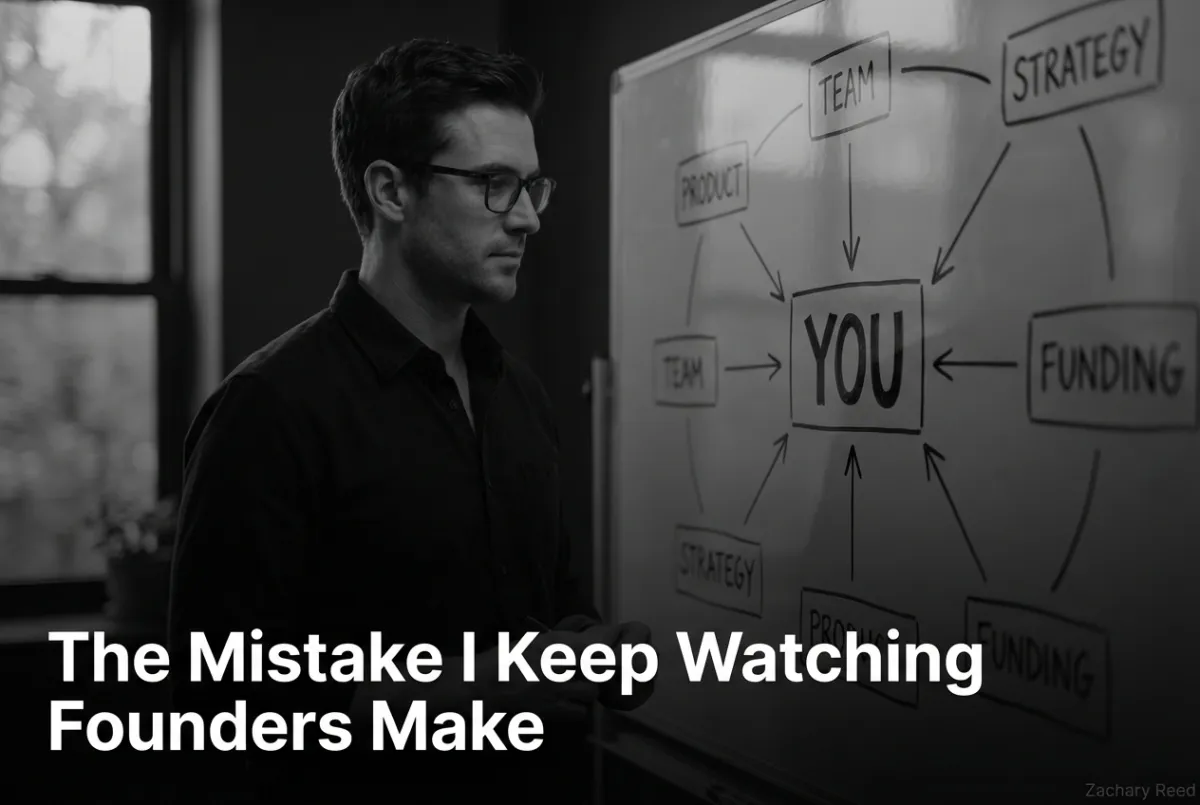
The Mistake I Keep Watching Founders Make
The Founder Who Outworks Everyone and Still Falls Behind
There's a type of founder I keep running into.
They're in first. They're out last. They answer every message. They're on the job site, on the phone, on the next proposal, on the follow-up. If you measured effort, they'd win. Nobody works harder.
And yet — the business is flat. Or barely growing. Or perpetually one bad month from fragility.
I've spent time this week thinking about why. Because I've felt versions of this myself. And I've watched it happen to people I respect.
The answer, I think, is that effort and design are different things. Most founders are running maximum effort inside a broken design. And no amount of hustle fixes a structure problem.
The Difference Between Working Hard and Building Right
Working hard is doing more. Building right is doing the right things in the right sequence with the right structure around them.
Here's what building right looks like in practice: decisions happen without you. Leads get captured even when you're unavailable. Processes run even when you're not watching. The business doesn't slow to a crawl when you take a weekend.
Working hard often looks like the opposite. You're the approval. You're the bottleneck. You're the one who catches what slips through. You're the answer to every question that shouldn't require an answer.
I don't say this to be critical. Early in building, this is unavoidable. You are the business. But there comes a point where the thing that got you here starts working against you — and you don't always notice because you're too busy being in it.
What I've Learned Building Two Companies at Once
Right now I'm running ClarityOS and Zachary Reed Consulting simultaneously. That's not a flex — it's a stress test I put myself through by design. Because I wanted to know: can I build two things that don't both require everything I have every day?
What I've learned is that the ones that run better are the ones with cleaner structure. Clearer lanes. More documented processes. Fewer decisions that have to route through me.
The ones that drain me are the ones where I haven't done that work yet. Where I'm still the answer to questions that should have a system.
The difference is never about effort. It's about architecture.
The Three Questions That Actually Matter
I've been using three questions to audit my own businesses — and I think they apply to almost any founder:
1. What happens when I'm unavailable for a day? If the answer is "everything slows down" — that's information. It means the business runs on you, not on systems. That's a design problem, not a scheduling problem.
2. What am I doing that someone (or something) else could do just as well? Be ruthless here. Most founders are doing $15/hour administrative tasks while their strategic thinking — the thing that actually creates value — sits unused. Not because they don't have the capacity. Because they haven't given themselves permission to stop doing the small things.
3. If I disappeared for two weeks, what would break? What breaks is a map of your structural gaps. Start there.
Building Is Slow. That's the Point.
The best thing I've read about entrepreneurship recently isn't from a business book. It's from Proverbs 24:27 — "Prepare your work outside; get everything ready for yourself in the field, and after that build your house."
Sequence matters. Preparation matters. Building the right thing in the right order — rather than just building as fast as possible — matters.
The founders who seem to be ahead aren't always working more. They've usually just done the structural work earlier. They've paid the design debt before it accumulated. They built something that could run.
The Work Worth Doing
If you're in a season where effort isn't translating — where you're grinding and still feel like you're behind — I'd encourage you to stop adding more to the stack. Instead, ask what's actually broken in the structure.
Usually it's one of three things: decisions routing too high, processes living in someone's head instead of a system, or no clear ownership over what actually needs to get done.
Fix one of those. The effort you're already putting in will start landing somewhere.
If this resonates and you're building a business that feels like it only runs because of you — take the OS Diagnosis at https://osd.zacharyreed.com. It's free and takes 10 minutes. You'll get a clear picture of where your operational structure has gaps.