You're Not Behind on Your Goals. You're Running on the Wrong Planning Cycle.
If you've ever hit October and quietly accepted that you're not going to accomplish what you committed to in January — you're not alone. And you're probably doing what most founders do: blaming focus, blaming your team, or blaming the year itself.
The problem isn't any of those things. The problem is your planning horizon.
Twelve months is too long. Not just for entrepreneurs, for any human operating at the edge of their capacity. There's a body of research showing that our natural focus cycle runs approximately 90 days before it needs redirection. We are wired for urgency. We are not wired to sustain it for 12 months.
And yet most companies, including most scaling companies with real revenue and real teams, are still running on annual planning cycles that work against this pattern rather than with it.
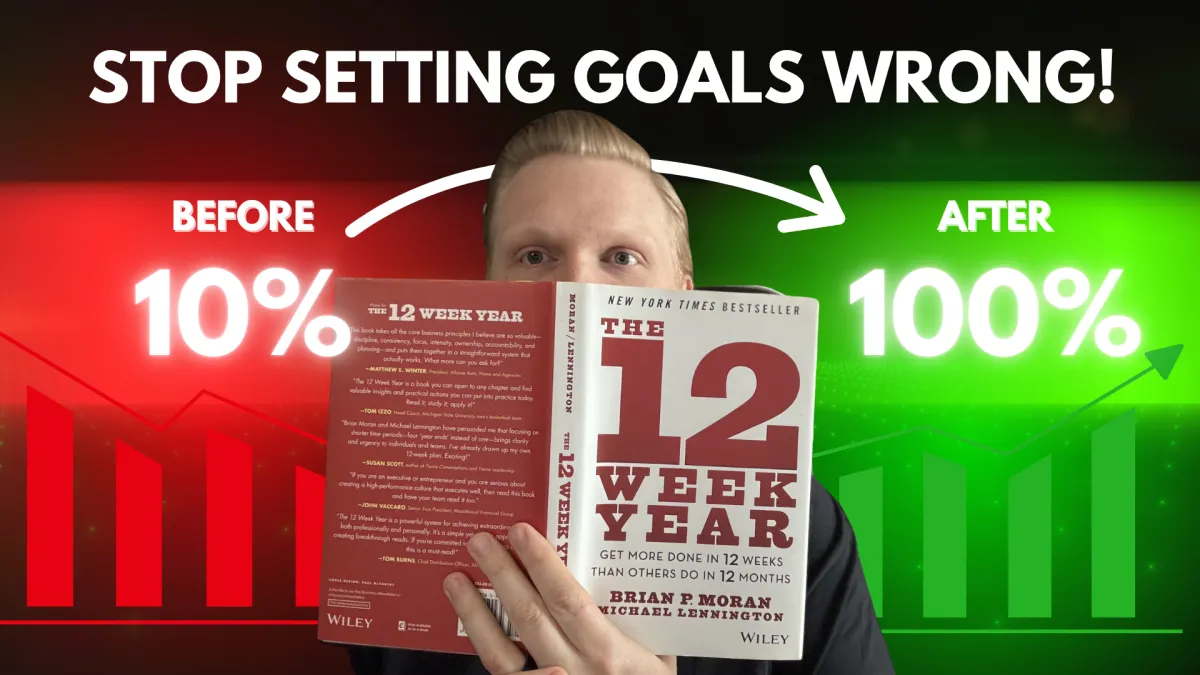
This is the insight behind The 12 Week Year by Brian Moran and Michael Lennington. And it's one of the most practical structural changes I've applied inside my own business.
The Real Cost of Annual Planning
Here's what actually happens inside most organizations on a 12-month cycle:
Goals get set in January. Everyone's energized. The first quarter has momentum. Then Q2 arrives and the urgency quietly bleeds out. You still have eight months. There's time. New priorities show up. The original goals get shuffled to the back of the agenda.
By Q4, there's a push. A year-end scramble. Businesses run big promotions, sales teams do all-hands sprints, founders pull late nights. Not because they're inspired, because they're behind.
That pattern doesn't happen because of poor character. It happens because urgency is a structural output, not a personality trait. When a founder or a team believes they have twelve months to accomplish something, the planning cycle guarantees they'll behave like it.
The book reframes this entirely. Instead of fighting human nature, you work with it. You compress the timeline.
What the 12-Week Year Actually Changes
The premise is simple: redefine what a year means.
Instead of operating on a January-to-December cycle, you operate on four 12-week cycles per year. Each cycle functions as its own complete year. It has its own goals, its own priorities, its own scorecard, and its own accountability rhythm.
At the end of 12 weeks, you don't coast. You close the cycle, assess what happened, and start again.
The result is that urgency never expires. Every 12 weeks, you're back at week one with real targets and real pressure to execute.
But here's what most people miss when they hear this framework: it only works if the goals are tied to weekly execution. A 12-week goal without a clear action plan behind it is just a shorter deadline on a wish. The structural mechanics matter.
How the Execution Architecture Works
Within each 12-week cycle, every goal should have a defined set of weekly activities, specific actions that need to happen in order for the goal to be reached. Not outcomes. Activities.
For example, if the goal is to hit a specific revenue target in 12 weeks, the activities might include a defined number of outreach touches per week, a set number of discovery calls, and a specific follow-up cadence. Those activities are tied to a scorecard. At the end of each week, you score yourself: did the activities happen? Yes or no.
This weekly scoring changes everything. Instead of waiting until week 12 to find out you missed, you know by week two whether your execution is tracking. You can adjust in real time, figure out whether you have an execution problem, a systems issue, or a prioritization gap, and correct course while it still matters.
This is the piece most goal-setting frameworks skip. They help you define what you want. They don't give you the weekly operating structure to actually get there.
I personally like to write goals using the SMART format: specific, measurable, actionable, with a defined time limit, because a goal written that way tells you what "done" looks like just by reading it. That clarity is what makes the weekly scoring possible.
The Time Blocking Discipline
One practical piece the 12 Week Year emphasizes, and one that I'd argue is non-negotiable for founders specifically — is time blocking.
Every key activity has to live on the calendar before the week starts. Not captured on a list. Blocked. If it's not on the calendar, it doesn't exist, because the week will fill itself with other people's needs and reactive demands.
This is particularly important for the activities that don't feel urgent but are strategically critical: the outreach, the content, the strategic thinking time. These are the things that move the business forward long-term. They're also the things that get crowded out first when the calendar isn't protected.
One of the most difficult lessons I've had to learn as a business owner is that if I'm not making intentional time for the things that need to get done — they're not going to happen. You have to schedule around the key activities, not in spite of them. When clients want to meet or other demands come in, I don't move things around to accommodate them if it means sacrificing a critical execution block.
I've also found that scheduling dedicated time to think — not doing, not executing, just thinking about the direction of the business — is one of the highest-leverage habits a founder can build. Most founders are so deep in day-to-day operations that they never look up long enough to ask whether they're heading in the right direction. Those strategic blocks allow you to work on the business instead of always being caught in it.
What This Looks Like at the Organizational Level
For a leadership team operating on 12-week cycles, the rhythm looks like this:
Every 12 weeks, the team identifies three to five goals for the cycle — the specific outcomes that will move the business most meaningfully. Not twenty goals. Three to five.
Each goal has an owner. Each owner maps the weekly activities required to reach it. Those activities get time blocked. Every week, the team reviews completion rates — not outcomes, activities. Because activities are leading indicators. Outcomes lag. If the team is hitting 85% or better on weekly activity completion, the goals will land.
At the end of 12 weeks, the cycle closes with a brief review: what did we hit, what did we miss, what do we carry forward. Then the next cycle begins.
This is an execution cadence. And most scaling companies don't have one. They have annual plans, quarterly reviews, and a hope that the team is executing in between. That gap is one of the clearest governance failures I see in companies between $2M and $10M — and it compounds quietly until the year-end scramble makes it impossible to ignore.
If you want to get started, the 12 Week Year website has free templates you can download. I've also used Notion to build out the tracking system.
But the place most people actually stall isn't the system — it's the goal itself. Most founders set goals that are too vague to score, too broad to own, and too disconnected from their real vision to keep them moving when the week gets hard. That's the problem I built the Smart Goal Coach to solve.
The hardest part of the 12-week framework isn't the system. It's getting specific enough about what you actually want to accomplish.
The Smart Goal Coach is a one-on-one coaching experience built directly inside ChatGPT. It asks the deep questions — the ones that force you to get underneath the surface of your goal and get real about what you're trying to accomplish and why. Then it builds a complete action plan you can drop directly into your 12-week cycle.
Available now at: https://smartgoalcoach.zacharyreed.com. Instant access. Use it on your phone, your laptop, wherever you think best.
If you're serious about making this your most productive 12 weeks yet — start there.